

In every artist’s journey, there are pivotal moments that redefine the course of their creativity. For Moroccan photographer Youssef, that moment wasn’t a triumph but a loss. What was once a world filled with pencil strokes and drawings transformed, through heartbreak, into a new lens of storytelling. Today, his photography feels cinematic, raw, and unshakably honest — an art that grew from the ashes of another passion.“I used to create stories with a pencil,” Youssef reflects, “but after a moment of loss, I discovered a new way to paint them.”
That loss happened about twelve years ago, at an unassuming café, during what should have been a simple gathering with friends. With him was his most precious possession: a portfolio containing every drawing he had created since childhood. It wasn’t just paper and ink — it was his creative identity, his personal history. But when he accidentally left it behind, it was gone forever. Returning hours later, he found only an empty table. That portfolio — and with it, the years of artistic devotion — had vanished.“The loss of that portfolio felt like the loss of my entire creative history,” he says. “I couldn’t get my passion for drawing back.”
It would have been easy to give up, to retreat from creativity altogether. Instead, Youssef picked up something new — not a pen, but his phone. While skateboarding through the streets, he began to snap pictures, almost absentmindedly at first. The act of noticing, framing, and documenting slowly began to replace the absence that drawing had left. And then, little by little, something shifted: what began as casual documentation evolved into street photography, and then into a profound love for the camera itself.
“Not a day goes by that I don’t document it with my camera or phone,” he shares. “Photography became the way I could create again.”Youssef’s style is hard to pin down in a single word because it feels at once deliberate and spontaneous, cinematic yet intimate. He describes it as a pure art approach, whether he’s walking the streets or capturing a portrait. His process isn’t about snapping and moving on — it’s about carefully composing, waiting for that fraction of time where life and beauty align.

“For me, it’s not just about documenting what’s happening,” he says. “It’s about shaping the moment into something artistic.”
This devotion to detail and composition is what gives his work its cinematic quality. A shadow isn’t just a shadow; a passerby isn’t just a passerby. Every scene has a story waiting to unfold. And Youssef, patient and precise, gives that story room to breathe.
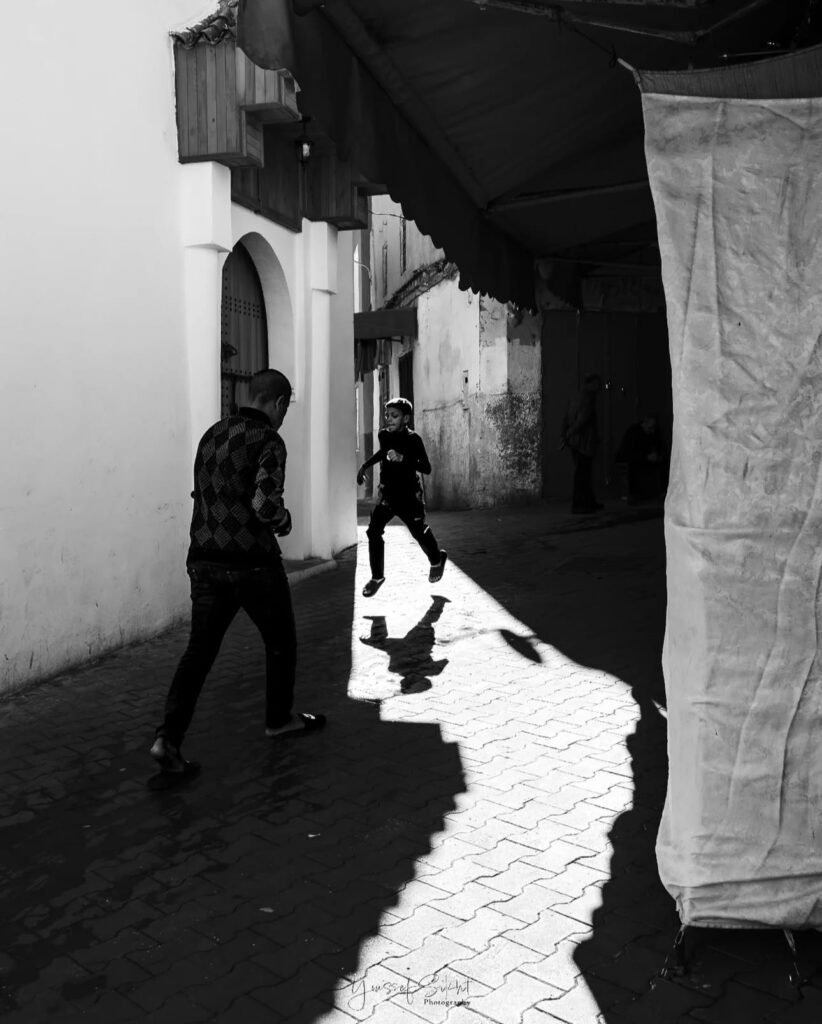
One of his most cherished photographs was taken in the Moroccan town of Sefrou. At midday, Youssef noticed how the sun cut the street in two, creating a stark boundary between light and shadow. For half an hour, he stood there, waiting — not forcing, not rushing, but allowing the street to gift him its story.
Then it happened. A child, bursting with life, ran across the divide, his movement cutting through the light like a brushstroke on a canvas. That moment, fleeting yet eternal, became the photo Youssef still treasures most

” Shadows, silhouettes and reflections “
“That photo means a lot to me because it captures not just a passing moment, but also the feeling of waiting, watching, and being rewarded with something beautiful and unexpected,” he explains.
When asked about inspiration, Youssef doesn’t point to a famous figure or a single muse. Instead, he draws energy from the journey itself — from the transformation of losing one passion and finding another. That experience fuels his hunger to uncover beauty in the everyday.
Undoubtedly we have no questions to ask which are unanswerable. We must trust the perfection of the creation so far, as to believe that whatever curiosity the order of things has awakened in our minds, the order of things can satisfy. Every man’s condition is a solution in hieroglyphic to those inquiries he would put.
“My greatest inspiration is the journey itself,” he says. “Every day presents a new opportunity to document life and to create narratives with people. That constant creative process is what inspires me most.”
At the heart of his photography
a desire to offer viewers more than just images. For Youssef, a photograph isn’t about clarity of what is seen, but about depth — what lies beneath, what waits in the silence between details.
“I want my work to feel like a quiet invitation for people to look beyond the surface,” he says. “I want them to feel a connection with the hidden stories in the frame, to step into the mystery and let their imagination complete it.”

This is what makes Youssef’s photography resonate so strongly:
it isn’t loud or showy, but it lingers. It asks viewers to pause, to consider, to feel. His photos are less like answers and more like questions — open doors leading to personal reflection.
Youssef’s story is proof that art doesn’t end with loss. Sometimes, it transforms, reshaping itself into a new language. From pencil sketches to shadows on cobblestones, from drawings that were taken to photographs that remain — his work embodies resilience.
Through his lens, Youssef has found a way not only to heal but to remind us all: beauty often waits in the ordinary, and the most profound stories are hidden in the quietest of places.

Check Out More Icons Around The World